Budget
What Actually Drives the Cost of a Bathroom Remodel
Why two bathrooms of the same size can be quoted worlds apart — and which decisions move the number most before a single tile is ordered.
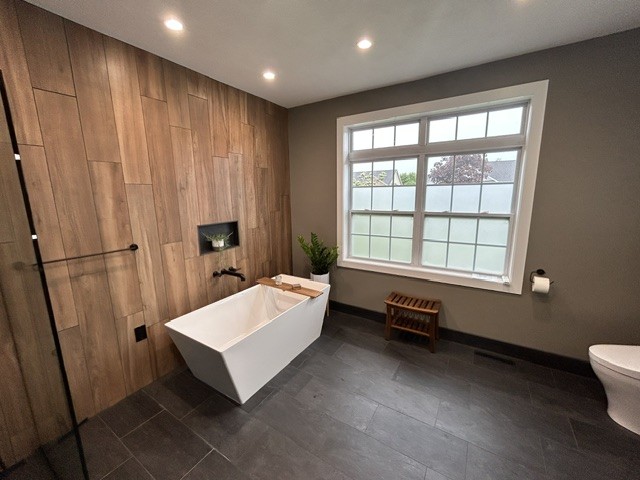
Square footage is the first thing most people reach for when they try to picture what a bathroom will cost, and it is one of the weakest predictors there is. Two rooms of identical size, in houses on the same street, can land a long way apart — not because one contractor is dearer than the other, but because they are not the same project.
What follows is the honest list: the decisions that genuinely move the number, roughly in the order of how much they move it. We have deliberately not put figures against them. Any price quoted on a website is a guess at your house, and a guess is worth nothing to you.
1. Whether anything moves
This is the single biggest fork in the road. A bathroom that keeps its toilet, tub and vanity where they already are is a finishes project. The same bathroom with the toilet shifted four feet and the tub swapped for a walk-in shower is a plumbing and framing project that happens to end in tile.
Moving a drain means opening the floor, and in an older house that can mean working around joists that were never placed with your new layout in mind. It is often entirely worth doing — a bad layout stays bad no matter how good the tile is — but it should be a decision you make knowingly rather than one that appears later as a change order.
A useful question to ask yourself early: is there anything about how this room works that frustrates me daily? If the answer is no, keeping the layout is the cheapest real improvement available to you.
2. What the demolition finds
Central New York has a great deal of housing stock old enough that opening a bathroom floor is a genuine question rather than a formality. Water that has been getting past a tub surround for years does not announce itself; it shows up as a soft spot in the subfloor on the morning of demolition.
No estimate can price what it has not seen. What an estimate can do is tell you plainly that this is a possibility, and set out how it will be handled: you are shown the problem, told the options, and given a price before any additional work goes ahead. That is the part worth checking before you sign anything.
3. The tile — size, pattern and the setting out
Tile is the area where material cost misleads people most. The tile on the pallet is rarely the expensive part. The labor to set it is, and that labor varies enormously with what you have chosen.
- Large-format tile needs a flatter substrate than small tile does, because it cannot follow a wave in the wall. Achieving that flatness is work that happens before any tile is set.
- Herringbone, chevron and anything laid on a diagonal generate far more cuts, more waste and more setting-out time than a straight stack or a running bond.
- Natural stone needs sealing, careful handling and sometimes a different setting material than porcelain.
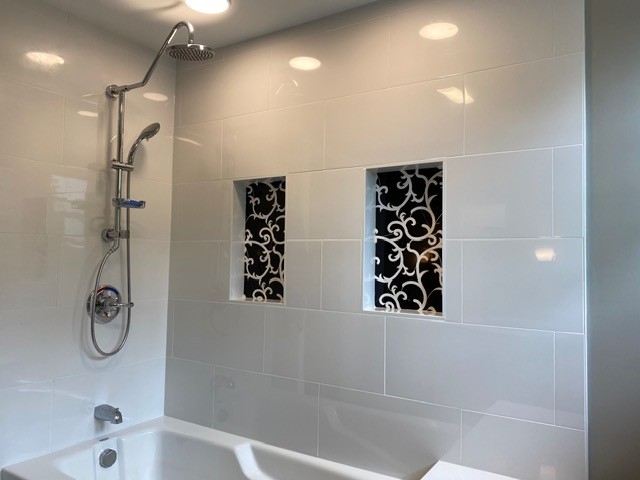
- A niche, a bench or a curbless entry each add detail work that a plain rectangular shower simply does not have.
None of these are reasons to avoid the tile you want. They are reasons to choose it early, with the labor understood, rather than discovering the implication after the quote has been signed.
4. Fixtures, and the allowance trap
Fixtures are the one category where you have close to full control, and where the range from the bottom of the catalog to the top is wider than in any other part of the room. A vanity, a faucet, a shower valve and a toilet can be specified sensibly or extravagantly, and the installation labor is much the same either way.
The trap is the allowance. When selections are not final, an estimate carries a placeholder figure for them. That is a perfectly legitimate way to produce a number early — as long as you are told it is an allowance, told what it assumes, and told what happens when you choose something above it. An allowance you did not know was an allowance is how a project goes over budget without anyone doing anything wrong.
5. What is behind the tile
Waterproofing, substrate and slope to the drain are invisible the moment the room is finished, and they are the difference between a shower that is still sound in fifteen years and one that is quietly ruining the floor beneath it. This is not the part of an estimate where there is money to be saved. It is the part where two quotes most often differ without the homeowner being able to see why.
So if you are comparing two numbers and one is noticeably lower, look here first. Ask each contractor to describe, specifically, how the shower is waterproofed and what the substrate is. Two straight answers that differ will tell you what the gap in price actually buys.
6. Time — yours as much as ours
A smaller bathroom typically runs about three to five weeks; a larger primary bathroom generally six to eight. Those ranges depend on the scope of the work, the materials selected, and what we find once demolition begins.
The cost that appears on no estimate is the one you pay if it is the only bathroom in the house. That is worth raising at the consultation rather than at the start of demolition, because it changes how the work is sequenced.
What barely moves the number at all
For balance: some of the things homeowners worry about hardest turn out to matter least. Paint color. Cabinet hardware. The exact shade of grout. Whether the mirror is round or rectangular. These are the decisions it is safe to leave until later, and leaving them until later is usually the best way to keep the early conversation on the decisions that genuinely carry weight.
How to compare two estimates properly
- Line by line, not total against total. A single figure hides every assumption inside it.
- Check that demolition, disposal, substrate and waterproofing are each named.
- Check which fixtures are supplied and which are allowances.
- Check whether the schedule is a range or a single optimistic date.
- Check what is warranted and for how long. Ours is a one-year installation labor warranty, with manufacturer warranties on materials and fixtures applying separately.
An itemized estimate is not a courtesy. It is the only form in which a quote can be checked at all, and it is why every estimate we write is broken out line by line. The consultation and the estimate are free, so the cost of finding out what your particular room actually involves is an hour of your time.
Recent posts
Planning
Questions Worth Asking Before You Hire a Remodeling Contractor
The questions that actually separate one quote from another — and what a straight answer to each of them sounds like.
Planning
Settle the Kitchen Layout Before You Choose a Single Finish
Cabinet doors and countertop slabs are the fun part, and the wrong part to start with. Here is the order of decisions that keeps a kitchen on track.
Materials
The Part of a Shower You Never See Decides How Long It Lasts
Substrate, waterproofing and slope to the drain are invisible once the job is done — and they decide whether a shower lasts or quietly fails.